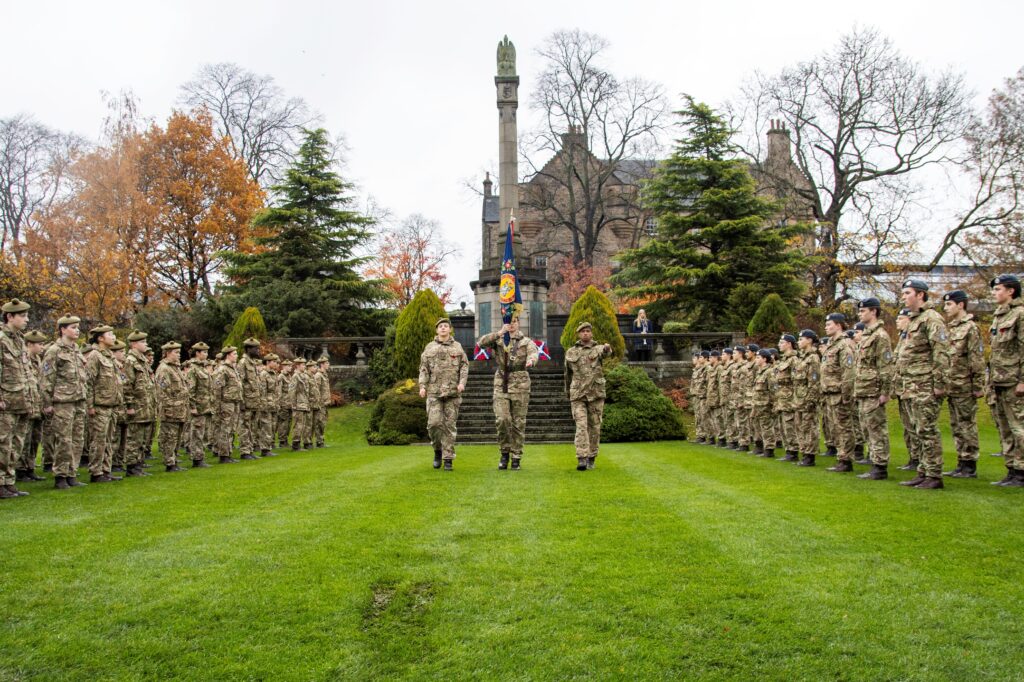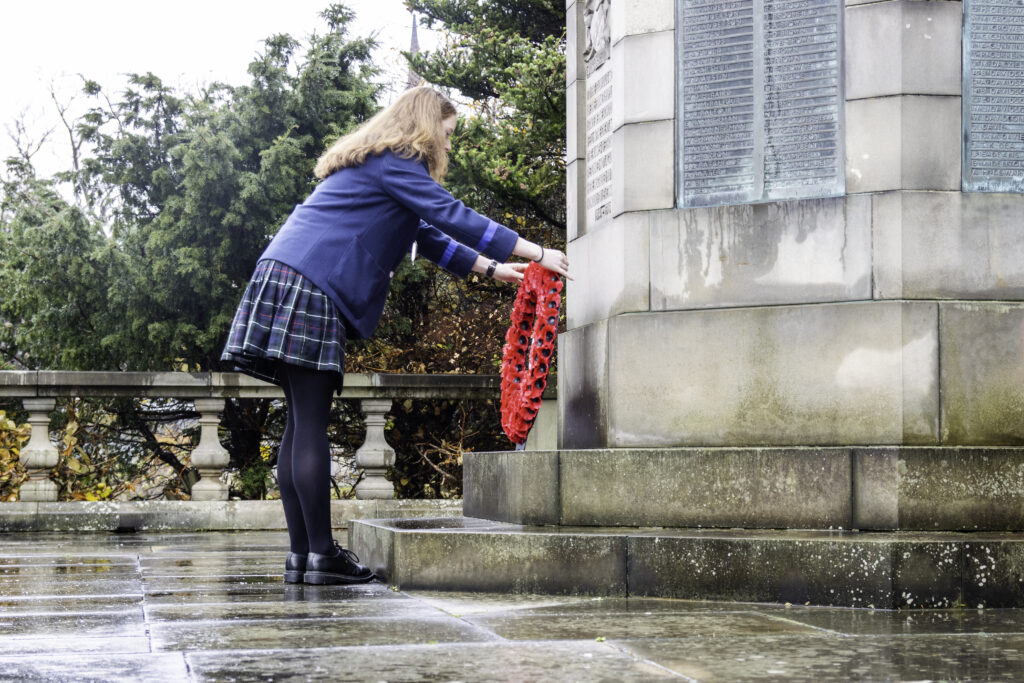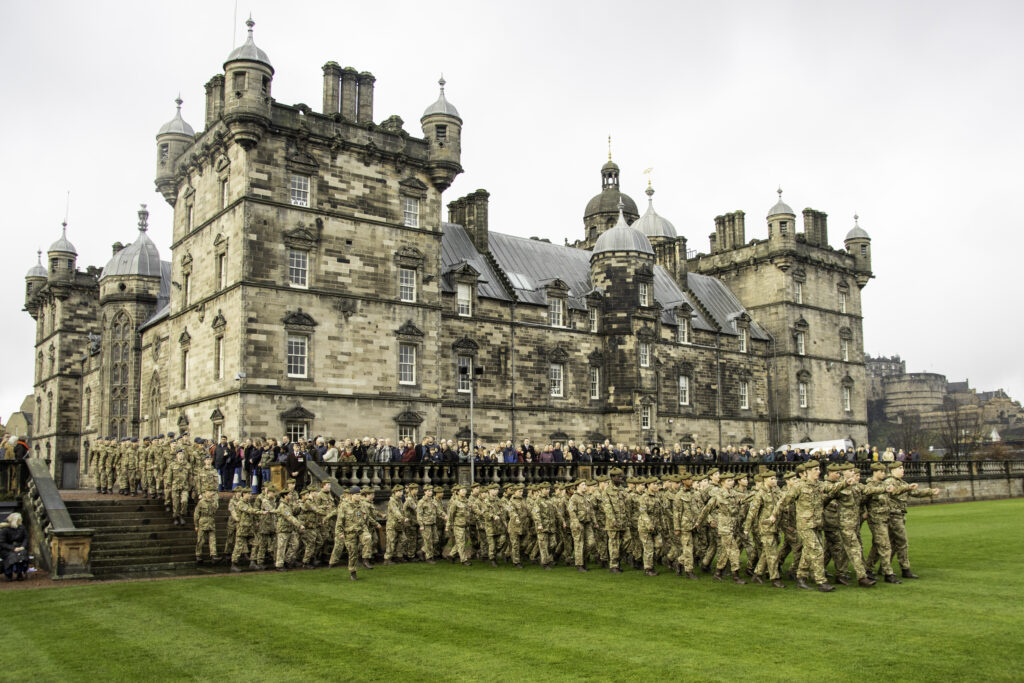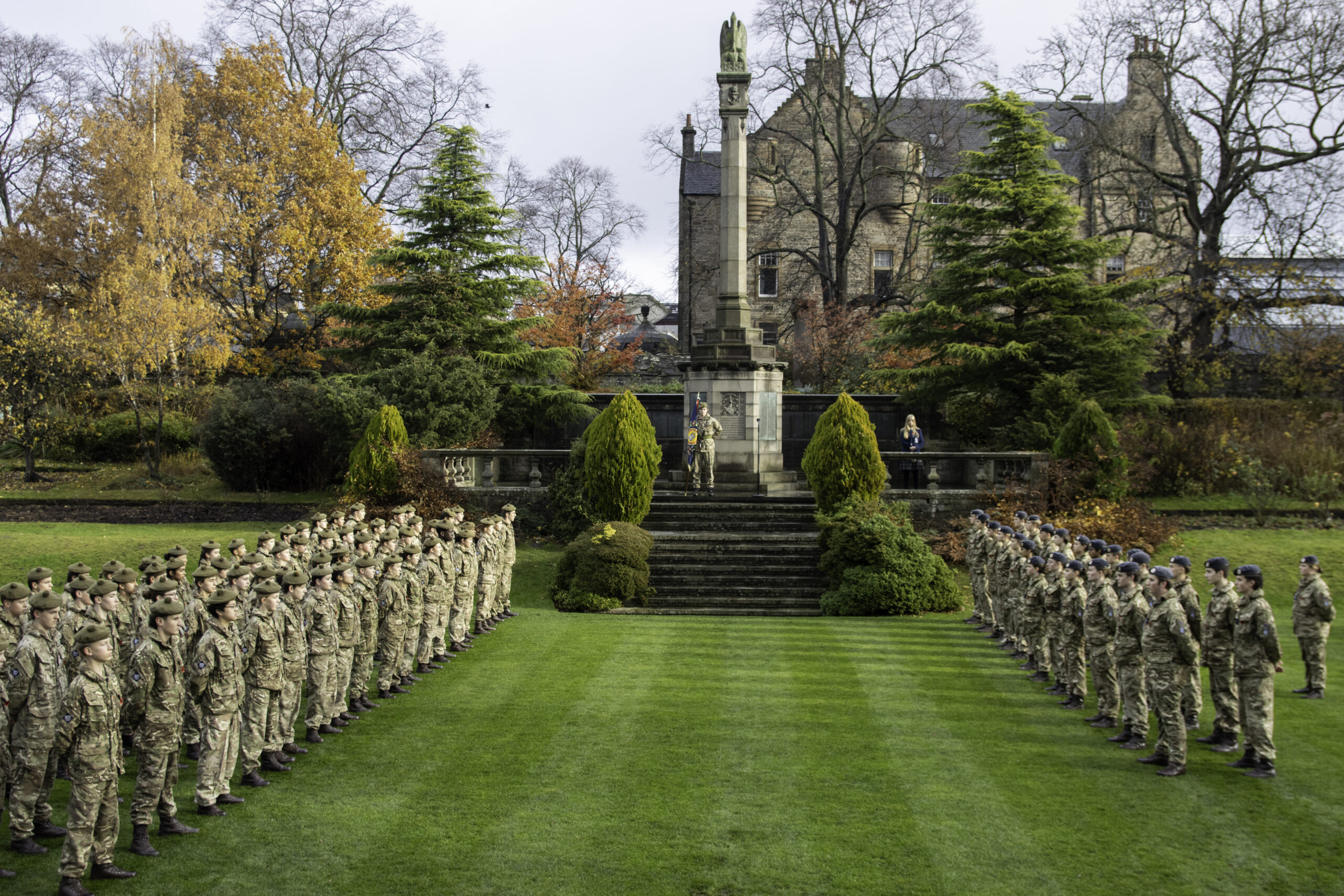
As communities across the country came together to mark Remembrance Day, Heriot’s took time to reflect on and honour the service and sacrifice of those who have given so much.
To mark Remembrance Day, the whole school observed a two-minute silence at 11am, pausing together in reflection and remembrance.
On Sunday, our cadets represented the school with distinction at the Remembrance Parade, demonstrating outstanding discipline, professionalism and respect throughout. They did themselves and the Heriot’s community proud as tributes were paid to those commemorated on our War Memorial.
During the Remembrance Service, a series of readings were shared, recounting events from Heriot’s history during the First World War. These readings are shared below.
McCrae’s Battalion
16th Royal Scots, also known as McCrae’s Battalion, was raised in Edinburgh by Sir George McCrae in November 1914. At a grand meeting at the Usher Hall he spoke as follows:
‘This is not a night for titles: I stand before you humbly as a fellow Scot, nothing more and nothing less. You know I don’t speak easily of crisis. But that is what confronts us. I have received permission from the War Office to raise a new battalion for active service. It is my intention that this unit will be characterised by such a spirit of simple excellence that the rest of Lord Kitchener’s army will be judged by our standard. Furthermore, with the agreement of the authorities, I have undertaken to lead the battalion in the field. I would not – I could not – ask you to serve unless I share the danger at your side. In a moment I will walk down to Castle Street (the local recruiting office) and set my name to the list of volunteers. Who will join me?’
Within hours of his speech, 300 men had volunteered and this number rose to over 1350 in less than two weeks. Eleven Hearts footballers initially volunteered, leading to many football supporters volunteering to serve alongside their sporting heroes. Other volunteers included rugby, cricket and field athletes. The 16th Royal Scots was the first of the so-called “Footballer” or “Sporting” battalions.
In November 1914, Sir George McCrae requested the use of Heriot’s school for training the 16th Royal Scots. Enlisted men were housed in what was the Castle Brewery (also known as the Heriot Brewery). This area now forms part of the Grassmarket campus. These buildings were owned by the school, and a bridge was built from the upper malting floor across to the school (to what is now the Greyfriars building). This allowed the soldiers easy access to and from the school.
The battalion stayed at Heriot’s for six months before going on manoeuvres in the Scottish Borders. In 1916 they landed in France and alongside the 18th Royal Scots spearheaded the British attack on the Somme. The 16th Royal Scots lost three quarters of their strength on the first day alone.
The Serbian Boys
The first ‘Serbian Boys’ came to Heriot’s in 1916. These boys, aged between twelve and seventeen, had survived what is known as the “retreat”: a treacherous journey over the mountains of Albania and Montenegro during the terrible winter of 1915-1916 to escape capture after their country suffered catastrophic defeat at the hands of Germany and its allies.
Twenty seven Serbian boys were educated at Heriot’s between 1916 and 1919. Over the three years they were hosted at the School, several shone academically. But it was on the playing fields of Goldenacre where they gained fame. These boys, who had never played rugby before, embraced the game and showed extraordinary and unexpected talent. Several were good enough to join the First Fifteen, where they played alongside future Scottish internationalists like Daniel Drysdale. They are further credited with having played the first Serbian international sporting match on the fields of Inverleith in 1918 and for having brought rugby back to Serbia following their return.
The 1916 edition of The Herioter magazine reported, “That the Heriot boys had been waiting the opportunity to show their goodwill to their friends from the far-off Balkan Peninsula was evidenced by the enthusiastic cheering which burst forth when the Headmaster, addressing the whole School assembled in the School Hall, extended to the Serbian boys a warm Scottish welcome.”
At the end of the war, in 1919, the boys left the school. Before they departed, they scraped together enough money between them to place a brass plaque in the school, in what is now the teachers’ staff room, to record their gratitude for the kindness shown to them here. After the war, without exception, they all returned home, all fundamentally changed by their experiences here.